Nova’s 2-hour drama, Darwin’s Darkest Hour, premiers today and will begin streaming online tomorrow. It looks pretty good. Also, Henry Ian Cusick plays Darwin so maybe it will satiate my LOST craving for a wee second.
Here’s the trailer.

Nova’s 2-hour drama, Darwin’s Darkest Hour, premiers today and will begin streaming online tomorrow. It looks pretty good. Also, Henry Ian Cusick plays Darwin so maybe it will satiate my LOST craving for a wee second.
Here’s the trailer.
Posted in Nature, Science, Animals, Earth, Random Interests
Tagged Darwin, Darwin's Darkest Hour, Henry Ian Cusick, Nova, video

I love bugs. I mean, I really love bugs. I only wish that I had microscopes for eyes so that I could appreciate them properly.
I think few things rival the beauty of a moth or the strangeness of a caterpillar (check out the Puss caterpillar below!) at the macro level. Like a butterfly, a moth spends most of its life in the larval stage as a caterpillar and later pupates into the adult form. The caterpillars are sometimes spiny, sometimes furry and always a complete mind-trip. The adults are colorful, furry and have amazing fan-like antennas. I’ve spent more time than I’d like to admit browsing pics of these little (and mammoth) creatures and still haven’t scratched the surface of the 200,000 or so different species.
Below I’ve posted some pics taken from Wiki Commons of a few species in their larval and adult stages. If you find these interesting, I highly recommend checking out a few of the Moth Pools on Flickr (here, here and here) where you can find some really amazing images. I honestly didn’t mean to go so apeshit on the number of photos I’m posting. What can I say.. I’m an obsessive dork. One moth just led to another. You know how that goes, right? Right?!

Oleander Hawk Moth
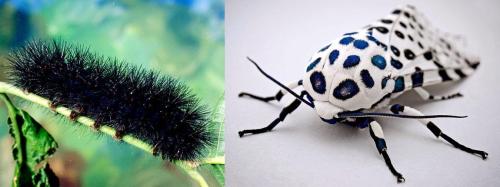
Leopard Moth

Saddleback Moth
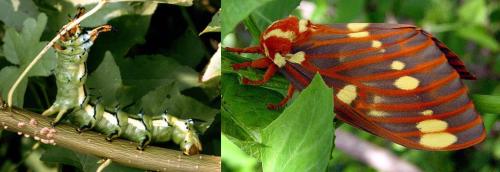
Royal Walnut Moth
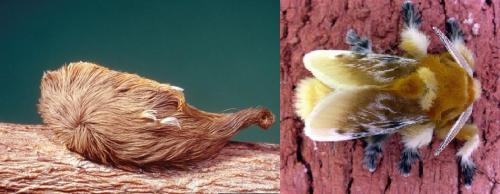
Puss Moth

Promethia Moth

Popular Hawk Moth

Luna Moth
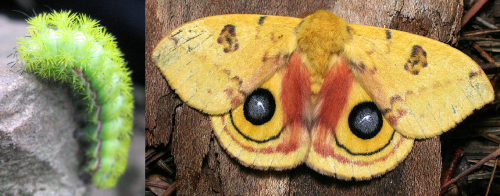
Io Moth

Hummingbird Hawk Moth

Garden Tiger Moth

Elephant Hawk Moth

Death's-Head Moth (How metal is that skull on its thorax?)

Cecropia Moth
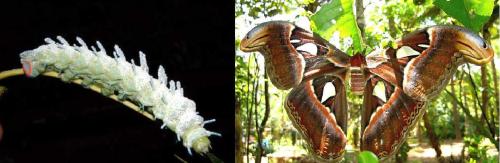
Atlas Moth
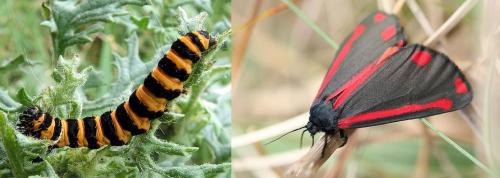
Cinnabar Moth

Emperor Gum Moth

Ermine Moth

Rosy Maple Moth

Spanish Moon Moth

Sunset Moth

Tussock Moth
Posted in Nature, Science, Animals, Earth
Tagged Atlas, Bug, Caterpillar, Cecropia, Cinnabar, Death's-Head, Elephant, Emperor Gum, Ermine, Garden Tiger, Hawk Moth, Hummingbird, insect, Io, Leopard, Luna, Moth, Oleander, Popular Hawk, Promethia, Puss, Rosy Maple, Royal Walnut, Saddleback, Spanish Moon, Sunset, Tussock
I’m really loving this series in New Scientist called Blueprint for a Better World.
Below are summaries and links to the points discussed in Part I. They make some interesting points which I’ve never considered. I’m not sure I agree with it all but there’s definitely some food for thought and discussion here.

The gist – Government should base policy on proven evidence instead of “what sounds good” to lobbyists and voters.
The big challenge is to get politicians and policy-makers to understand what constitutes rigorous evidence and to base their decisions on it, rather than on the urgings of lobbyists. The only alternative is to spend vast sums on programmes and policies that, far from achieving their aims, may be making matters worse.

The gist – Drug prohibition does nothing to decrease the number of drug users, but it does increase illness, death and robbery as well as allowing criminals involved in the illegal drug trade to become powerful and dangerous.
Taking any drug – including alcohol and nicotine – does have health risks, but a legal market would at least ensure that the substances people ingest or inject are available unadulterated and at known dosages. Much of the estimated $300 billion earned from illegal drugs worldwide, which now funds crime, corruption and environmental destruction, could support legitimate jobs. And instead of spending tens of billions enforcing prohibition, governments would gain income from taxes that could be spent on medical treatment for the small proportion of users who become addicted or whose health is otherwise harmed.

The gist – Although complicated due to privacy issues, databases of citizen’s DNA would allow officials to convict the guilty and release the innocent much more frequently.
Many other countries are wrestling with this issue. One possible answer – not yet adopted anywhere in the world – is to record everybody’s profiles at birth or on entry to the country. A universal DNA database of this kind would not solve all crimes: in many cases, no DNA sample is available, or would be irrelevant because the alleged perpetrator’s identity is not in question. But it would ensure a match could be found for most crime-scene DNA samples, while also ensuring people arrested but not convicted are treated no differently to the rest of the population. There is no other way to achieve this.

The gist – A new measurement which takes into account life satisfaction and sustainability is needed instead of counting success in GDP dollars.
That’s not to say that money plays no role in our well-being; the inhabitants of the poorest nations have the worst health and the lowest life satisfaction. But above a certain threshold, increasing wealth seems to matter less and less to our overall well-being. As a result, focusing on GDP as the prime measure of progress gives only a partial picture of social and personal welfare. A better indicator is needed.
5 – Find Out if We Can Cool the Planet

The gist – Geoengineering may be our best option for cooling the planet while we look for ways to reduce carbon emissions, however, it is not without its dangers.
… Given the possibility that researchers have underestimated the scale and speed of climate change, and with emissions rising faster than ever, it would be foolish not to investigate what geoengineering might achieve. Is it our best bet for ensuring that Earth remains a benign home to future generations, or a dangerous delusion? We need to find out.
6 – Tax Carbon and Give the Money to the People
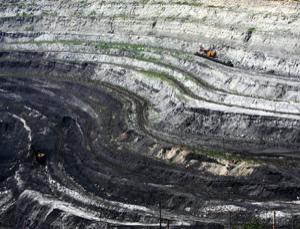
The gist – A universal carbon tax should be charged during the initial purchase of the fuel. This cost would trickle down to the consumer persuading them to use less fossil fuels. In addition, the revenue from the taxes would be redistributed to those making the greenest choices.
A universal carbon tax could be far simpler. NASA climatologist James Hansen is a vocal proponent, favouring a variant in which fossil fuels are taxed at source or at a country’s port of entry. The most polluting fuels in terms of carbon emissions, such as coal or tar-sand-derived oil, could be taxed more heavily than others. Consumers would not pay the tax directly, but its effect would permeate through to everything from the price of gas to the price of food: the more carbon-intensive goods or services are, the more heavily they will be hit.
7 – Learn to Love Genetic Engineering

The gist – Bioengineering could play a major role in saving the planet by producing stronger and more nutritious crops.
It won’t be easy. Farming causes more global warming than all the world’s cars, trains, ships and planes put together. The worst culprit is a greenhouse gas called nitrous oxide, a breakdown product of nitrogen fertilisers (including organic ones). Next in line is methane from livestock and manure. To meet demand for food and other materials such as biofuels without turning all the remaining wilderness into farmland, and without producing yet more greenhouse gases, we are going to have to exploit every trick we can.
8 – End the Pillaging of the High Seas

The gist – Large areas of marine reserves are imperative to the health of the oceans and its inhabitants which provide endless benefits and services to us.
The oceans provide us with many vital services: a significant proportion of the food we eat; underpinning for the tourism industry that is many countries’ lifeblood; soaking up half of the carbon dioxide we pump out, and much more. But pollution and overfishing are taking their toll. In places, entire habitats are being destroyed, from fishermen dynamiting reefs to trawlers trashing slow growing deepwater corals. Fishing fleets roam increasingly far afield and work in ever deeper waters. Mining the deep-sea floor for minerals and other destructive forms of exploitation are on the horizon. And looming above it all is the threat posed by climate change and ocean acidification

The gist – Money talks when it comes to encouraging companies and the public to help in creating renewable energy.
This approach is known as a feed-in tariff, and since Germany introduced feed-in tariffs in 1990, the proportion of electricity it generates from renewable sources has grown from less than 3 per cent to about 15 per cent in 2008. By comparison, the UK, which tried to boost renewable energy through an alternative “green certificate” scheme, generated just 5 per cent of its electricity from renewable sources in 2008.
10 – Take Friday Off.. Forever

The gist – A 4-day workweek has a number of benefits, including increased energy conservation, decreased unemployment rates and improved morale and personal satisfaction.
The full results of this experiment won’t be published until October, but an ongoing survey of 100 buildings suggests energy consumption has fallen by around 13 per cent. The survey also found that 70 per cent of employees prefer the 4/10 arrangement, and that people took fewer days off sick.
[All pics from newscientist.com]
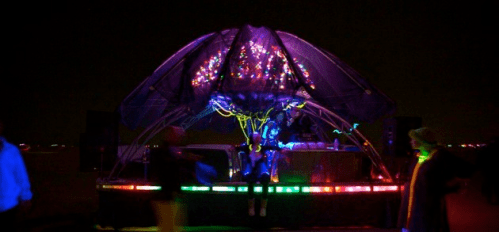
Come to the Poor Yorick art studios Friday or Saturday to see the funky Jellyfish from the year 12000. Kell has logged quite a few hours helping our mad scientist friend Jared and his crew convert an old van into this amazing art car. Aside from manual labor he did the coding for the lights. Come check it out!


Vodpod videos no longer available.
Posted in Art, Nature, Science, Animals, Earth
Tagged Art, Art Car, Jellyfish 12000, Poor Yorick, Salt Lake City, SLC
Another favorite TED talk. David Gallo shows video footage of luminescent deep-sea creatures and camouflaging cephalopods. Have I mentioned lately that I can’t stop thinking about cuttlefish?
Vodpod videos no longer available.
Posted in Nature, Science, Animals, Earth
Tagged animals, camouflauge, cephalopods, cuttlefish, David Gallo, ocean, octopus, squid, TED, Underwater Astonishments
The Age of Stupid is a new docu-drama set in the future (2055) after climate change has done great damage to humanity. The main character (Pete Postlethwaite) is a historian who looks back at footage from 2008 and wonders why we didn’t stop climate change while we still had a chance.
The film is premiering world-wide on Monday (Sept 21), for one night only, with the hopes of breaking the Guinness World Record for the biggest simultaneous film screening.
After the film, a live feed from a premier in New York will feature a performance from Thom Yorke (Radiohead) and comments from Kofi Annan (Nobel Peace Prize) and James Hansen (environmental scientist).
You can buy tickets for the Salt Lake screening here. It plays at Century 16 Theater at 5:30pm.
I’ve already got tickets, so see you there!
Below is a trailer and a short news clip.
Posted in Nature, Science, Animals, Earth, Travel, Hobbies, Events
Tagged climate change, movie, SLC, The Age of Stupid, Thom Yorke
 I just read in this week’s New Scientist that the US Department of Energy has granted this company, Solar Roadways, $100,000 which will help them to prototype their invention. They want to develop photovoltaic panels which they hope to embed in the country’s roads and parking lots to help solve the energy crisis. What a brilliant idea! Plus it looks like you’re driving around in the fantastic 80’s movie, TRON. Sweet.
Below is an interview with one of the creators.
Vodpod videos no longer available.
Posted in Nature, Science, Animals, Earth
Tagged energy, green, power, solar power, solar roadways, TRON

Spider Bowie / Human Bowie
The Heteropoda davidbowie is distinguished by its large size and yellow hair, and is only found in parts of Malaysia.
Bowie was apparently selected for the honour because of his musical contribution to arachnid world – the 1972 concept album The Rise and Fall of Ziggy Stardust and the Spiders from Mars.
Peter Jäger, the German spider expert who discovered the Heteropoda davidbowie, said that naming spiders after celebrities helped draw attention to the marginal status of many species as human activity destroys their habitats.
Environmental authorities have traditionally proved reluctant to include spiders on lists of endangered animals, but campaigners like Mr Jäger argue that their decline undermines nature’s genetic diversity.
“It is working against time,” he told The Observer. “We are also quickly losing genetic resources that have evolved over more than 300 million years.”
Last year the Rameshwaram Parachute Spider was among thousands of creatures included on a “red list” of endangered species complied by the International Union for Conservation of Nature (IUCN).
Less than 500 of the spiders are though to remain, as their woodland habitats on the Indian island of Rameshwaram, close to Sri Lanka, are cleared to make room for hotels and tourist resorts.
Posted in Nature, Science, Animals, Earth
Tagged David Bowie, Heteropoda davidbowie, Malaysia, spider
This is really interesting (and pretty funny). According to this video, the monkeys’ individual desire for alcohol varies one from another, similar to human patterns.
I love this TED talk by Richard Dawkins in which he describes how our perceptions limit our understanding of the universe.
Vodpod videos no longer available.
Posted in Nature, Science, Animals, Earth


 Battle Bunny